
ArkOS 0.13: Variants and Samples
by Péter Szilágyi
We’ve just released ArkOS 0.13.1, along with a large set of associated tooling. For the observant among you, we skipped 0.13.0. It was signed, but a last-minute API change made us pull it.
ArkOS 0.13.1 is a significant feature release. It ships support for the structural and copy number genomic variant files; extends the biofs API surface and example apps with new types of genomic queries. Comes with tools that can seed an Ark with any of 3,202 sample genomes for testing.
Let’s expand on all these!
Three kinds of variants
The Ark can currently ingest three types of your genomic data files. Small variants, structural variants and copy number variants. The latter two are new in this release, the former was supported until now. Let’s explain all of them!
When a sequencing lab gives you your whole genome sequence results, it is not actually standalone data, rather it’s a diff against a reference chain everybody uses (of which there are like 15 different versions). Even more interestingly, many labs give you three diffs, not just one!
One of these diffs is the “small variants”, which is the industry name for small changes (of 1 to 50 base-pairs) where your DNA is different from the reference genome. These changes can be substitutions (reference has A, you have G), insertions (reference has nothing, you have extra CG) and deletes (reference has AG and you have nothing).

The tools that generate the small variant files, however, stop at changes around 50 base-pairs (bp). That does not mean your DNA does not have much longer changes vs. the reference chain.
New tools were made that specifically piece together large spans of diffs that your genome has, versus the reference, called “structural variants”. These can hold insertions and deletions, just like your diff file from the previous section; but they can also track a few other quirks: duplications (a larger span is repeated 2x), inversion (a larger span is reversed), and translocations (a larger span teleports from somewhere else).

Lastly, in perfectly ideal circumstances, everyone should have 2 copies of everything in their genome (one from each parent, lets ignore X/Y now). In reality, it can happen that a DNA section is copied more than once from a parent, or forgotten to be copied altogether. This can lead to you having more- or less copies of a gene than the reference says you should. Across many generations, these can pile further up.
These variants are interesting, because they can mean that some feature in your body is missing or maybe in overdrive (whether that’s good or bad is a different question). Long story short, there’s yet another diff file for tracking these changes, called “copy number variants”.

Annoyingly, these variant files are created by different tools with their own choices when it comes to ambiguity, so not only are the diffs slightly imprecise (due to the sequencing machinery), but they will even conflict with one another from time to time.
With the current release of ArkOS, we can ingest all three of the above. The structural and copy-number needs the small variants uploaded first.
New example apps
To demonstrate the utility of the new structural and copy number variant data slots on the Ark, we’ve also shipped two new example apps available on Ark Hub. Both are data demos, just for fun.
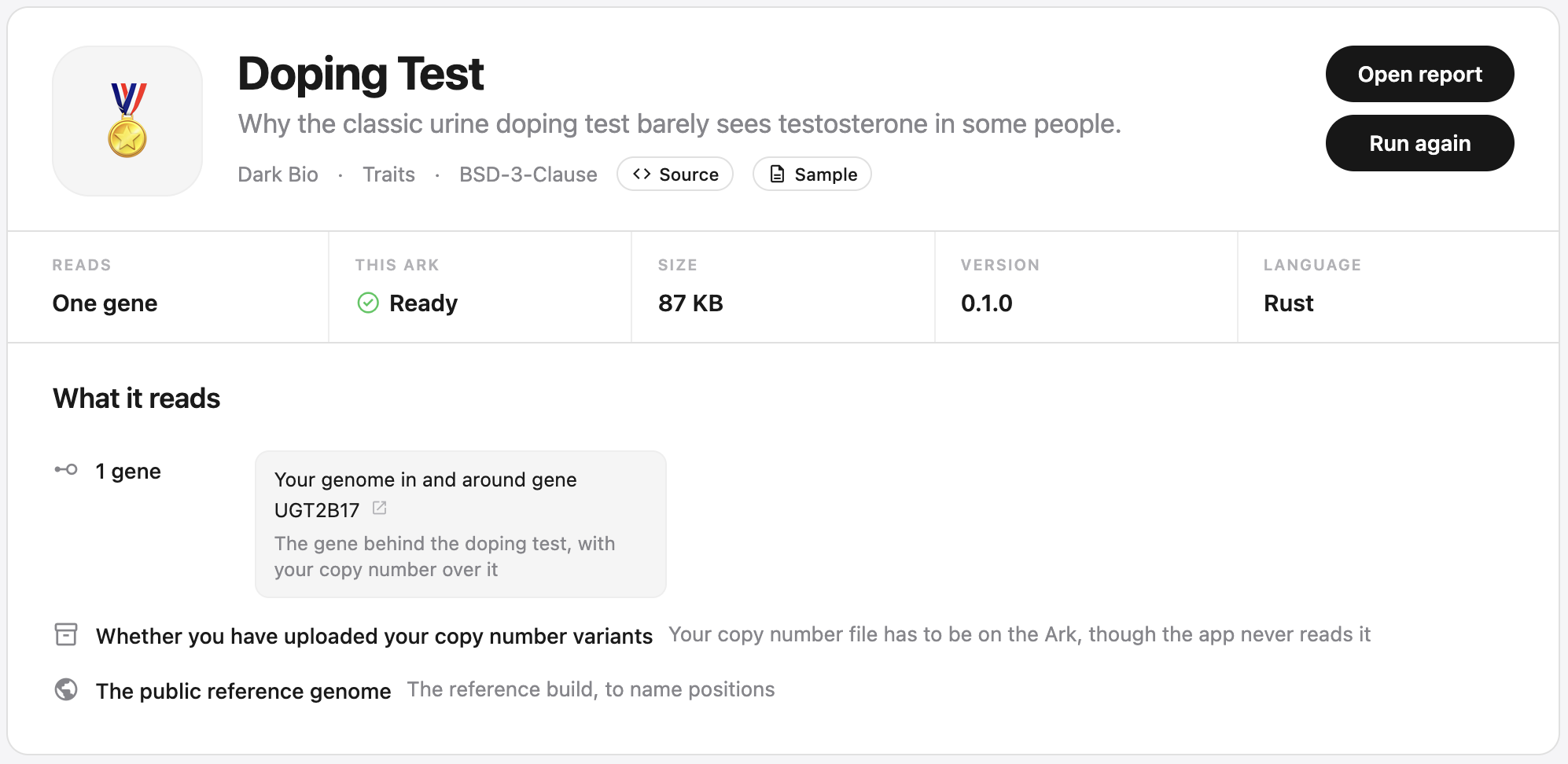
One of them is a “Doping Test”. Many doping tests operate by measuring the person’s testosterone level in their urine. This works because our bodies dump testosterone, so the more we have, the more it surfaces. The problem is, that doping tests assume everyone’s body behaves the same, whereas it does not in reality.
The testosterone-into-urine dumping is regulated by a gene called UGT2B171,
and “normal” people have 2 copies of it. Guess what happens if you have a
(common) mutation where you have only one copy or perhaps even zero? Yup,
you become invisible to doping tests234! Perfect test to do before you next
marathon! =)
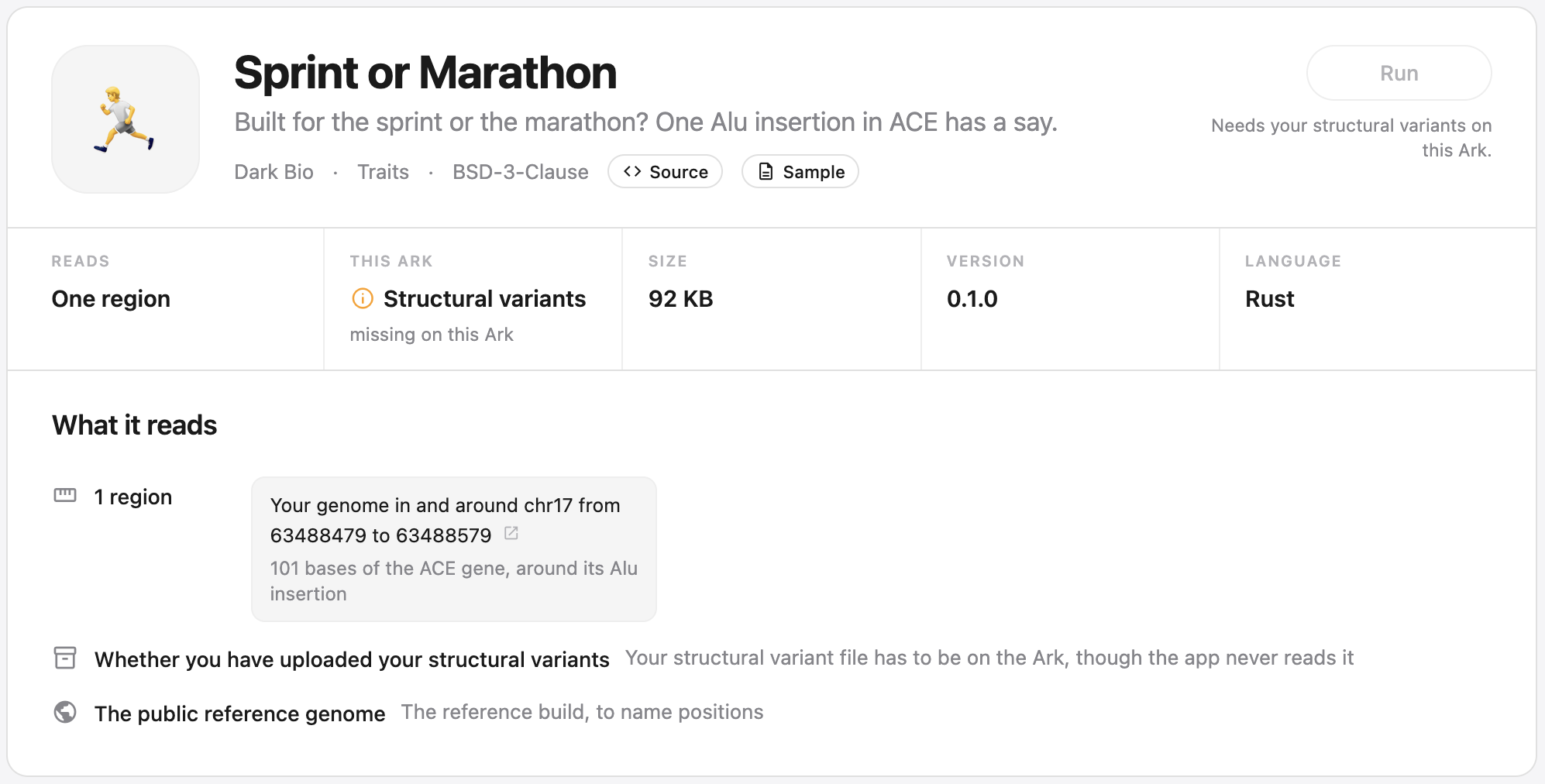
The other example app can tell you if you’re better at Sprint or Marathon,
with all the disclaimers you can imagine. This is based on an observation
that endurance athletes carry an Alu insertion in the ACE5 gene more often
than others do678.
Maybe it was never your fault that you couldn’t run a marathon! Ok, still your fault, but at least it wasn’t motivation, but genetics…
Public samples
Ok, caught your attention, but you don’t have your genome sequenced (yet). Worry not, you can still play with the Dark Bio ecosystem. In the v0.13.x release family, we’ve also added support for seeding an Ark (or Emulator) with one of 3202 sample genomes from the 1000 Genomes Project.
You can do that either from the Ark Hub web UI or via the ark CLI tool. We
recommend the CLI as that caches downloads, so you don’t need to pull that
dataset again if you wipe your Ark and start over. Note, both tools refuse
to seed a sample into an Ark that already holds data, to avoid mixing data.
Updating ArkOS
You can upgrade physical Arks either via Ark Hub or with the ark tool.
Everything else in Ark Hub and the latest ark needs ArkOS 0.13.1, so
update first. Ark Emulator releases have been published with the new
firmware embedded.
Compatibility
ArkOS v0.13.x is a breaking release.
The new features require reindexing previously uploaded small variants. Due to the newness of the platform, we’ve decided against migrating any datasets (and maintaining it forever) and ask existing users to please reupload their small variant files.
Similarly, the variant catalog slot needs to be expanded with some data
that was previously discarded. This, unfortunately, requires downloading
it again onto the Ark for reindexing. Note, if you use the ark CLI tool,
downloads get cached on your laptop, so you only need to reprocess it.
Apps reading the old genome paths need updating too, and the example apps show the new ones.
Apologies for any inconvenience!
Transparency logs
Check our transparency repo for the ArkOS v0.13.1 HSM signing proofs.
Until next time…
-
NCBI Gene, UGT2B17. https://www.ncbi.nlm.nih.gov/gene/7367 ↩︎
-
Schulze JJ, et al. Doping test results dependent on genotype of uridine diphospho-glucuronosyl transferase 2B17, the major enzyme for testosterone glucuronidation. J Clin Endocrinol Metab. 2008;93(7):2500-2506. https://doi.org/10.1210/jc.2008-0218 ↩︎
-
Wilson W 3rd, et al. Characterization of a common deletion polymorphism of the UGT2B17 gene linked to UGT2B15. Genomics. 2004;84(4):707-714. https://doi.org/10.1016/j.ygeno.2004.06.011 ↩︎
-
Jakobsson J, et al. Large differences in testosterone excretion in Korean and Swedish men are strongly associated with a UDP-glucuronosyl transferase 2B17 polymorphism. J Clin Endocrinol Metab. 2006;91(2):687-693. https://doi.org/10.1210/jc.2005-1643 ↩︎
-
NCBI dbSNP, rs1799752. https://www.ncbi.nlm.nih.gov/snp/rs1799752 ↩︎
-
Rieder MJ, et al. Sequence variation in the human angiotensin converting enzyme. Nat Genet. 1999;22(1):59-62. https://doi.org/10.1038/8760 ↩︎
-
Montgomery HE, et al. Human gene for physical performance. Nature. 1998;393(6682):221-222. https://doi.org/10.1038/30374 ↩︎
-
Ma F, et al. The association of sport performance with ACE and ACTN3 genetic polymorphisms: a systematic review and meta-analysis. PLoS One. 2013;8(1):e54685. https://doi.org/10.1371/journal.pone.0054685 ↩︎